
In Belconnen General Practice, there’s a time that occurs repeatedly that brings us back to why we made the decision to follow this career path. A patient who has been attending one of our doctors for blood pressure checks for 5 years, and who could have gone to any bulk billing clinic in Belconnen, casually says that last year they were in a bad patch and didn’t come in until they knew that their GP would not be happy with them. The doctor said to the patient, “Now you’re here, that’s what’s important. In that short discussion were the building blocks of what a long-term healthcare relationship can be.
This is quite different from the transactional relationships that are common in much of today’s healthcare. A true partnership with your GP is not just about going to the same GP over and over. It’s about establishing a relationship in which both patient and GP are on the same page, are able to communicate with one another, and are on the same team.

long-term healthcare relationship
A True Healthcare Partnership
Our Belconnen General Practice doctors have recognised that the relationship between doctors and patients is built on certain practices and attitudes, and after over 10 years in family practice, they have seen this first-hand. Not automatic; it needs a conscious effort from the patient and GP.
Honesty is the First Element
There are a number of elements involved in a real healthcare partnership. Honesty is the first thing it is. If a patient is confident in their GP, they are more likely to be honest about any behaviours or symptoms that they are concerned about. If someone drinks too much, he or she is not embarrassed about it. A person who has difficulty taking medication can talk about the difficulties without judgement. A fearful person can express his or her fear of a symptom.
This honesty is key as the GP’s advice comes from information, and if they are not aware of the true situation, then the advice will not be effective. If the patient does not tell the doctor when they are feeling unwell, they will not be treated according to reality. When someone doesn’t mention drinking, health risks are not addressed. The partnership asks patients to come to the appointment as themselves.
Shared Decision Making
Second, it is about shared decision making. A true partnership is not a doctor merely prescribing a treatment; it is about discussion. The doctor explains options, provides evidence, and discusses risks and benefits. The patient asks questions, shares concerns, and offers his or her own insight into what has worked for him or her in the past. They make a plan together which the patient is able to follow.
This matters enormously. Take, for example, a patient who has a slightly raised cholesterol level and a GP wants to prescribe medication to him. In a transactional healthcare system, the physician writes a prescription for a statin. The doctor may ask: “How do you feel about medication? Do you want to give lifestyle changes a try? What obstacles could be in your way? If the patient is worried about side effects, that worry is dealt with, not ignored. Patients prefer exercise over medication if they would be more inclined to do the exercise. Patient’s preference for exercise over medication affects the plan.
The Impact of LTRs on Health Outcomes
The evidence of long-term GP relationships is strong. The health benefits of patients with a GP visit are significantly higher on most outcomes if they continue to have regular contact with their GP. They experience:
- Reduced emergency department attendances
- Reduced hospital admissions
- Improved chronic disease management
- Increased treatment satisfaction
Real-World Example: Sarah’s Diabetes Management
One of our doctors explains this using the example of one of our patients, Sarah. Five years ago, Sarah was diagnosed with type 2 diabetes and joined the Belconnen GP. At her first visit, her HbA1c was 8.2%, which wasn’t ideal, but it was manageable. Sarah visited her GP on a regular basis every 2 months over the following years. The doctor’s visits were not only to see her glucose levels, but her life. Did she feel stressed at work, and was this impacting her eating? How was her mood? Was she exercising?
The doctor began to see patterns over time. Blood sugar was well controlled in the quiet months, but became more difficult to control during the busy months. Instead of prescribing more medication, the doctor assisted Sarah in learning strategies for managing her stress. Sarah’s blood sugar level slowly rose to 6.8%, which is a great improvement. However, Sarah was more concerned with her health than that. She knew what she knew: that there was a link between stress and blood glucose. She began exercising on a regular basis. She felt that she was being cared for by someone who truly cared about her physical, mental, and emotional health.
This is a transformation from curing a disease to helping a person who has a disease and is living with it, and that’s what happens with sustained relationships. It takes time and consistency, something that transactional healthcare doesn’t have.
The Trust Element: Foundation of Everything
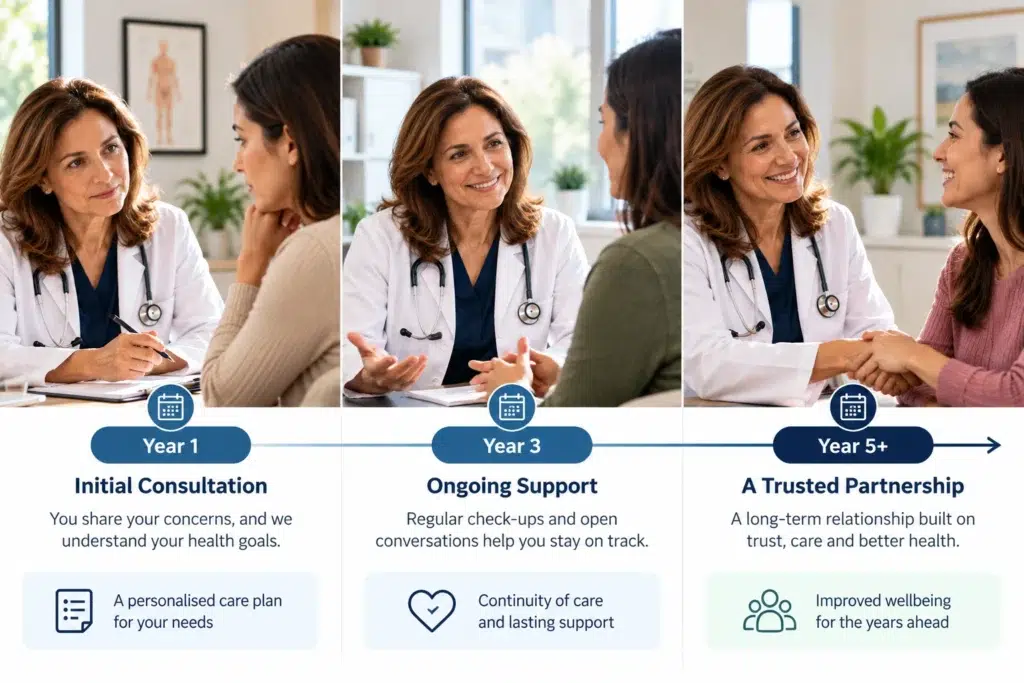
Trust is likely the best thing that comes out of a long-term healthcare relationship. Trust is a key factor for Australian patients in providing important information, following recommendations, and participating in preventive care. The distinction is between a person who presents with a health issue and someone who is embarrassed about their health issue and therefore doesn’t come in.
long-term healthcare relationship
How Trust is Built
We’ve seen that trust is built over a few regular experiences at a family practice in Belconnen. Trust develops through three key mechanisms:
1. Being Listened To
First, trust is established when patients feel that they are being listened to. This includes appointments during which the doctor actually listens to what you are saying and does not jump to conclusions. It involves asking questions that go beyond the initial question when something does not make sense. It involves recognising that a concern is legitimate even if it may not seem to be a medical emergency.
2. Consistency Over Time
Second, trust builds gradually through consistency. If you have been seen by the same doctor over and over again, he or she will recall information you shared months ago. They pick up on minute changes in your delivery. They show that they are concerned about your well-being, not just in isolated appointments.
3. Demonstrating Care for Your Wellbeing
Third, trust accumulates through experiencing that your GP values your wellbeing. This could be that they changed a medication because you complained of side effects, although the medicine was actually working. It may involve sending you to a counselor if you are having emotional problems, not only treating your physical ailments. It involves offering suggestions that you may not want to hear, but you know are good for you, and you are genuinely wishing you would be successful.
Addressing the Barriers: Making the Relationship Work
There are some practical issues that Australian patients encounter with a GP on a regular basis.
Accessibility of Appointments
Accessibility of appointments is one major challenge. It’s hard to keep a relationship if you cannot get appointments (the waiting room is always crowded), if appointments are rushed, if you are unable to reach the clinic, etc.
That’s one of the reasons why bulk billing family health centres are important. Bulk billing medical centres in Belconnen are helping Australians to keep a regular GP without any financial hurdles. People should not have to sacrifice continuity for affordability.
Doctor-Patient Compatibility
Doctor-patient mismatch is another obstacle. Sometimes you visit a GP, and then you don’t make a connection. Your communication style is not effective with you. Your values aren’t in sync. You’re not sure of their trustworthiness. So in this case, it’s not about giving up on long-term relationships; it’s about finding the right doctor. This could also involve seeing another doctor at the same clinic. It may involve changing to another Belconnen family practice clinic.
This is important since you are going to be spending years with this person working on your health. In all relationships, it is important to select a partner who is compatible with your personality, values, and communication style.
What the Patient Can Do to Develop the Relationship
It’s not just the GP’s job to establish a long-term healthcare partnership. Patients are actively involved. There are a few practical things that will help in the relationship:
- Be Consistent – Select a clinic and doctor, and make that your regular GP. Schedule appointments on a semi-regular basis even if you do not have symptoms, such as annual health checks or more often, if you have chronic conditions. When you’re consistent, your GP will know that you’re in it for the long haul.
- Be Honest and Open – Discuss difficulties with GP regarding medical recommendations. Let them know if you’re not using your medicine as directed. Talk about any concerns regarding suggested treatment. Give your doctor background information about your life so that he or she can get a complete picture.
- Come Prepared – If you have more than one concern, make a list of them. Carry pertinent information such as medication lists, past test results, notes regarding symptoms. This makes it easier for your doctor to make the most of their appointment time and demonstrates your involvement with your health care.
- Follow Through on Recommendations – Follow through on recommendations or discuss why you can’t. If your doctor suggests lifestyle changes and you don’t make them, that’s fine, but let your doctor know at your next visit. Explain the barriers. You may discover together other solutions that are more suitable for you.
- Give Feedback – Finally, give feedback. If you are not satisfied with something about your care, tell us. If you need longer appointments, talk about it. You can ask for written summaries of what was discussed if you would like them. Communication about what works and what doesn’t is essential to good long-term relationships.

long-term healthcare relationship
The Long-Term View: Health Across Your Lifespan
A long-term GP relationship may offer a long-term health benefit that isn’t often recognised. Your doctor, who has been around for 10 years, will come to know your health history. They see trends over the years. They know the early warning signs, as they know your baseline.
This long-term perspective allows preventive medicine in the true sense. Your doctor doesn’t just screen for diseases by age and risk factors; he or she screens you based on you. They detect issues early as they are aware of the minute changes. They guide you ahead of time, according to your personal and family history.
We have patients who have been with us for 15, even 20 years at Belconnen General Practice. These relationships allow us to do medicine in a truly preventive and truly personalized manner. We are not just treating diseases when they occur; we are preventing them, knowing our patients so well.
Investment That Pays Dividends
A long-term healthcare partnership with your GP is a true investment. It involves choosing a general practice in Belconnen (or your area) to attend regularly and being honest and open. It takes time to build the relationship and communication about what you need to get from your healthcare.
This investment, however, has a lot to offer:
- Better health outcomes
- More effective healthcare
- Greater satisfaction with your care
- A physician who understands you and cares for your health
- Personalized healthcare experience
In Australia, where the healthcare system is becoming more complex, this connection is even more beneficial for patients. Your regular GP is your medical home, coordinating your care, knowing your values, and supporting your health across circumstances and over time.
FAQs
How can I determine if I have the right GP to develop a relationship with?
The right GP is a GP that you feel is listening to you. Following an appointment, were your concerns addressed? Does the doctor talk in a way that you can understand? Are you rushed or not rushed? Are they interested in your life, beyond your symptoms? Trust your instincts. Sometimes it’s a particular doctor at a medical centre in Belconnen. A few times you have to test it out before you get the right fit. You’ll know it’s right when you feel comfortable, respected, and cared for. This sensation will gradually occur over a couple of visits, not right away, so wait and see.
If I have a bad appointment or the relationship doesn’t feel right, what should I do?
First, try a couple of visits, one poor appointment does not mean that the relationship will not last. Stress or situation may lead to an off appointment. If several appointments seem rushed, overlooked, or incongruent with your values, speak up about it. You may express it like this: “I don’t feel we’re getting along well. Can we discuss how to improve this?” When no changes are made, it is reasonable to look for another doctor in the same practice or another one. It’s important to get it right and it’s not a big deal to keep going.
How often should I go to my regular GP to keep a real GP relationship?
This will depend on your health condition. Annual preventive visits are effective for people who are generally healthy. For those with chronic conditions, visits every three months or half-year are typically appropriate. It’s not about how often you go to the GP, it’s about who you go to regularly. It is more important that you form a habit that your GP expects and that you attend this habit. Predictable contact is more effective than random contact for building relationships.
I have always had a thing for changing doctors. Is it too soon to start a long-term relationship?
Absolutely. Find a clinic, a family practice or bulk billing medical centre in Belconnen, and agree to go to a single doctor. First, make a longer appointment and let them know that you would like to form a continuing relationship. This clarity is welcomed by most GPs. In 3-4 uniform visits, you will start enjoying the continuity benefits. It’s never too late to start.
What can I do to get the most out of my GP visits to improve our relationship?
Bring a list of concerns and be candid about lifestyle and barriers to recommendations; provide context for life situation. Follow up with what you talked about after every appointment or if you can’t, say so next time. If there have been any changes in your medications or health since your visit, send a message. Attend scheduled appointments on time. Above all, be honest and open. Your GP can only get to know the true you.