
The Importance of Preventive Health Checks
Health is your greatest treasure. Preventive health evaluations enable you to discover possible issues before they become major diseases. Regular health checks can help your GP find potential health issues at an early stage – when treatment is usually easier and more effective – without waiting for symptoms to develop.
Consider preventive care as maintenance for your car. Breakdowns are avoided by regular maintenance. So does your body. A preventive health assessment evaluates your overall health and identifies health issues that you may not have noticed.
Severe health issues can occur without any symptoms being heard. In many cases, diabetes, high blood pressure and early stage cancers do not have any symptoms. By the time you start feeling unwell, a lot of damage may have been done. Preventive screening turns that equation upside down.
Knowing the age-appropriate screening recommendations. Knowing the guidelines for age-appropriate screenings.
There are various health concerns for various age groups. The screening options that your GP recommends will depend on your age, your health history and your risk factors.

Preventive Health Assessments in Belconnen | Early Detection & Wellness Checks
For adults between 25-40
Emphasis turns to formation of healthy habits and early detection of risk factors. During these years, people have regular blood pressure checks, cholesterol screening, and cervical cancer screening for women.
In adults age 40-60
This is a pivotal time to identify chronic diseases. The need for breast cancer screening, cardiovascular screening and diabetes screening increases. Men should talk to their GP about prostate cancer screening.
Screening increased for adults age 60+
Bone density tests, thinking tests and cancer screening remain appropriate, and as new issues such as falls and mobility are introduced, they are also examined.
Your GP will consider which screening(s) are appropriate for you, not a blanket screening.
Cancer Screening: What’s right for you?
The goal of cancer screening programs is to save lives by catching cancer at its earliest stages, when the odds of a successful treatment are best.
Bowel Cancer Screening (Ages 45+)
Bowel cancer is one of the most preventable cancers if it is detected early. Your stool is tested for blood at the screening appointment or you may have a colonoscopy to look directly at your colon.
The National Bowel Cancer Screening Program provides free bowel cancer screening kits to most Australians aged 50-74. Talking about screening at age 45 is a good way to get a head start, particularly if you have any family history concerns.
Sometimes colonoscopy can evoke fear, but it is a very good screening tool. Your GP can talk to you about whether you’re eligible and what the procedure entails.
Cervical Cancer Screening
A pap test or a liquid-based cytology test is the screening methods used for cervical cancer. These tests are able to detect change in cells of the cervix before they become cancerous.
Cervical screening is recommended for women aged 25 to 65 years with sexual activity every 5 years in the Australian Cervical Screening Program. New screening tests are very accurate and not highly invasive.
Depending on how often you should have screening may be less frequent if you have been vaccinated with HPV vaccine. Your GP will make a recommendation based on your vaccination and screening history.
Regular screening for breast cancer (from 40 years old)
Breast cancer screening using the mammogram can catch breast cancer before you or your doctor can feel a lump. The Breast Screen Australia program offers free mammograms for women from 50-74 years of age, although screening discussions should begin prior to this age.
It is important for women aged 40 to 49 to talk to their GP about their personal risk. Whether earlier screening is recommended or not depends on other factors such as family history, past breast problems, or hormonal changes.
Self-awareness of the breasts is also crucial. Be familiar with normal changes in your body to alert your GP early.
Prostate Cancer Screening
Prostate cancer screening is unique in that it is not a screening program for everyone (as is cervical and bowel screening). Rather it is a personal choice that you make with your GP.
A PSA (prostate-specific antigen) blood test is also available to find prostate cancer, but it has some drawbacks. Can cause false positive results and can be used to detect cancer that would never cause it any harm. Men aged >50 years (or >45 years, if Aboriginal ancestry or a family history of prostate cancer) should talk to their GP about the benefits and risks of screening.
Cardiovascular Risk Assessment
Cardiovascular disease is still a major health problem. Cardiovascular risk assessment is designed to help identify risk factors for a heart attack or stroke.
In your assessment you examine:
- High blood pressure: High blood pressure may be asymptomatic, but it is definitely an increase in the risk of heart disease.
- The levels of cholesterol (the total and the ratio of HDL and LDL cholesterol).
- Blood glucose: High blood glucose at night is a sign of diabetes risk
- Weight and waist measurement: These measurements are used to determine metabolic health.
- Family history: People whose families have been affected by heart disease are at higher risk.
- Smoking is a significant risk to the cardiovascular system: Highly raises the heart and blood vessel risk.
These measurements allow your GP to work out your ‘absolute cardiovascular risk‘ over the next five years. This allows for an assessment to be made as to whether any lifestyle modifications are enough, or whether medications may be useful.
Health benefits are substantial with even minor improvements on these areas. Minimal drops in blood pressure or in cholesterol levels significantly lower the risk of heart disease.
Preventive Health Assessments in Belconnen | Early Detection & Wellness Checks
Knowing your blood pressure numbers is crucial. It is very essential to know about your blood pressure numbers.
Blood pressure is measured as a pair of numbers, the systolic (top) and the diastolic (bottom). A normal blood pressure reading is less than 120/80. The top number (systolic) is the pressure exerted during contraction of the heart, and the bottom number (diastolic) is the pressure exerted between contractions.
High readings should be investigated. Your GP may suggest that you use a home blood pressure machine so that you can take accurate readings, because for some people, their blood pressure can show high readings because they are anxious in medical environments (the white coat effect).
The Cholesterol Picture
It’s important to know the total cholesterol, but it’s even more important to know what your cholesterol breakdown is. The “bad” cholesterol (LDL cholesterol) causes blockage of the arteries. The good cholesterol (HDL) helps to keep the arteries healthy.
Your GP considers the proportion of these types instead of just total cholesterol. A person who has total cholesterol at 220 may have good ratios and therefore be at a lower risk of developing heart disease, while a person with total cholesterol at 200 may have poor ratios and thus be at a higher risk of developing heart disease.
Lifestyle changes (diet, exercise, weight management) make a difference to cholesterol without taking any drugs. If your cholesterol results show a higher risk, your GP will talk to you about changes to your diet before recommending taking medicine.
Diet and Nutrition
The food we eat has a profound effect on our health. Eating plenty of vegetables, fruits, whole grains and lean protein protects against disease. Your GP or dietitian can talk to you about specific changes in your diet that can help prevent chronic diseases.
Weight Management
The consequences of excess weight are diabetes, heart disease and some cancers. Any weight loss, even modest (5-10% body weight) is significant for improved health outcomes.
Your GP talks about sensible strategies for losing weight, not crash diets.
Your GP’s involvement in preventive care.
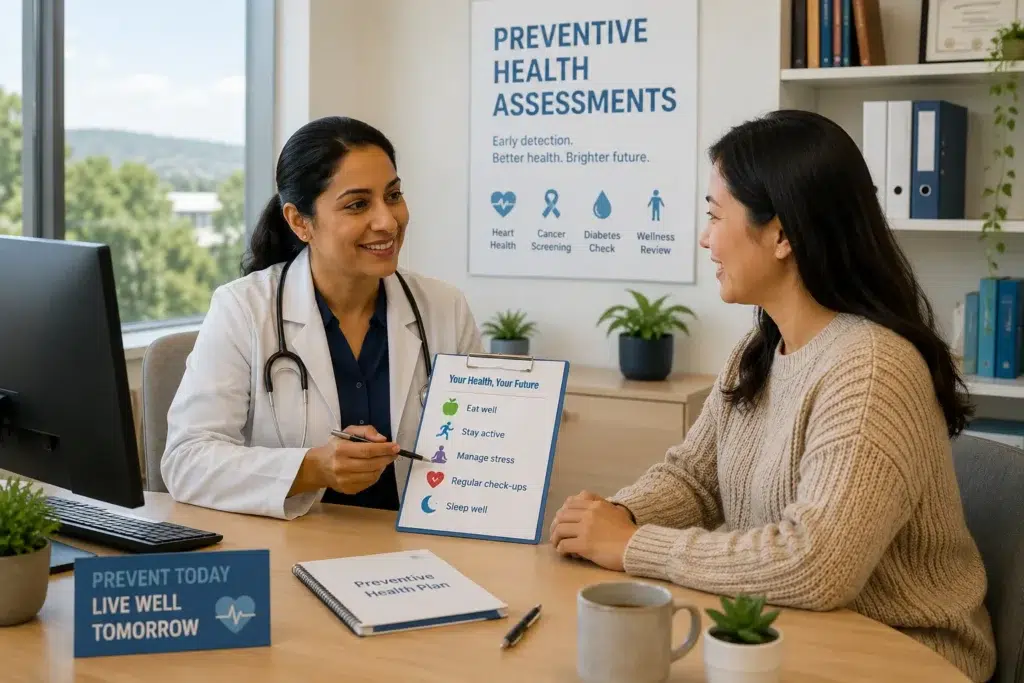
Your GP is your health care collaborator in prevention. They are aware of your medical history, family history and personal risk factors. This enables them to tailor screening recommendations rather than using a one-size-fits-all approach.
At a preventive health assessment, your GP will:
- Have a detailed medical and family history checked.
- Talk about how you live and about your health
- Perform physical examination
- Have the right tests depending on your age and risk profile
- Use results without the need for jargon.
- Talk about what will happen now, and what you are worried about
- If necessary, update medications.
- Give mother and daughter tips on how to live their lives. Give mother and daughter tips on how to live their lives.
This holistic approach is much more effective than individual tests, as they are not in context.
Knowing the results of your screening tests.
Test results can be very confusing. The more you know what they are, the better you’ll make health-related choices.
Normal results indicate that you are NOT affected by the condition tested. A normal screening test result, however, doesn’t necessarily mean that you won’t ever develop a condition, but rather that you’re at lower risk at this time.
A “false-positive” result does not necessarily indicate that there is a serious problem. Certain tests can alert for possible issues that need to be explored. Your GP will explain the meaning of your abnormal results and what will be done next.
If the results are borderline, they may mean that the person is at moderate risk. Your GP may suggest further tests, lifestyle changes or monitoring instead of immediate treatment.
Get your doctor’s advice:
- What was being tested and why (what are the variables)
- The meaning of your particular result
- A decision for follow up must be made based on the specific situation.
- What to change to improve based on results
- When you should have repeat testing
Conduct follow-up and next steps.
Use of screening is only effective if results are followed and recommendations are acted upon.
Your GP may suggest you have a screening for a condition if they think you are at high risk
for example:
- Lifestyle changes (diet, exercise, stress reduction, quitting smoking)
- Medications to lower risk factors
- Refer for specialist assessment for further evaluation
- Multiple testing at regular time periods
- Symptom monitoring of development
Taking action on these recommendations is crucial. Many people have screening results but don’t take preventative action, and thus miss opportunities to prevent serious illness.
Making Screening Decisions
Not all tests are right for all individuals. Screening decisions should take into account the benefits, risks, and preferences.
If you have been advised to have a screening, ask your GP:
- What is the disease that is being tested?
- How common is this condition?
- So what are the advantages of early detection?
- What do you think are the risks of screening (false positives, unnecessary treatment)?
- What if the screening test is abnormal?
- How frequently do I need to be screened?
- What are the costs?
- Am I at risk for breast cancer that makes screening more important?
These questions are not to be deemed intrusive by your GP. Shared decision making, with knowledge of screening options.
Putting It All Together.
Preventive health assessments are among the most critical things you can do to ensure your long-term health. They move health away from cure to prevention, enhance quality of life and lower health care expenses.
They do regular preventative evaluations which means:
- More timely diagnosis of serious cases at optimal treatment time
- Identification of risk factors that can be modified (changed)
- Baseline measurement to monitor over time
- An assurance of your health status and peace of mind.
- A sense of empowerment in your own health care
The best time to have started preventive screening was years ago. Today is the second best time.
Detect health problems in their early stages. Schedule a full preventive health check-up appointment with your GP, Belconnen. You will thank yourself for taking this crucial step toward a healthy lifestyle in the long run.
FAQs
1: How often should I have a preventive health assessment?
- Age-appropriate frequencies (25-40, 40-60, 60+)
- Chronic condition considerations
- GP recommendations
2: Do I need to fast or prepare for preventive health screening blood tests?
- Fasting requirements
- Test-specific preparations
- Medication guidelines
- Hydration
- Clothing tips
3: What does it mean if screening finds something abnormal?
- False positives
- Early detection
- Further testing needs
- Lifestyle management
- When not to panic
4: I feel healthy. Do I still need preventive screening?
- Silent diseases
- Symptom-free conditions
- Prevention benefits
- Peace of mind
- Real-world examples
5: Are preventive health assessments covered by Medicare or private insurance?
- Medicare coverage details
- Private insurance options
- Bulk billing
- Out-of-pocket costs
- Value for money